top of page

Problem-Solving Methods for Students
Practice Guides
We provide problem-solving “templates” and tools useful for student-led solutions to local challenges. In addition to step-by-step guidance, we offer worksheets and detailed explanations as needed.

Simple AI Auto-Generation of Meeting Minutes
In four steps—record → transcribe → draft with generative AI → have a human verify—it walks through how to make meeting minutes and handover materials from a single smartphone, down to the specific app names. By turning what was said into a record, you can reliably leave decisions and a senior’s experience with the team.

Network Diagram
A tool that organizes the necessary work and its order into a single diagram by working back from the final deliverable (the goal). By looking ahead to later steps, you prevent overlooking foreseeable tasks and the last-minute “we won’t make it.” The branching of parallel work becomes the division of roles, and each task’s deadline is set from the main event date. Make a first draft with generative AI and finish it with human verification.

Kanban Board
A very simple progress-management tool that simply turns tasks into one card each and posts them in three columns—To Do / In Progress / Done. Through the “transparency” of everyone seeing the status of all work, duplication and neglect decrease, and much of the back-and-forth of asking about and reporting progress becomes unnecessary. You can start in minutes with a wall and sticky notes, or with Miro.

Persona + Package Design
A tool for depicting the person you want to reach as one fictional individual (a persona) with a name and even an age, and, together, designing on a single sheet the value (a package) that answers their troubles. Rather than ending at “for everyone,” you fix the plan’s axis toward a person whose face you can see. Because portraits and images can be made with generative AI, many teams make use of it.

Root-Cause Analysis Logic Tree
In problem-solving, you need to act on the cause behind the phenomenon, not the immediate phenomenon. It is a tool for systematically digging into causes, visualizing them in a tree diagram, and identifying essential challenges. Writing them out while discussing as a team lets you escape off-the-cuff solutions.
Journey Map: Basics
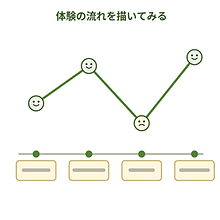
A framework that visualizes the challenges of each scene along the emotions in the course of a user experiencing a service. You can review an event or app you planned from “the side of the people who use it.” It is a guide for becoming able to create a full journey map for a local challenge you are interested in.


bottom of page