

Campus Toolbox Beta
— Student-led methods and case studies for solving local challenges —
In solving local challenges, when students drive projects on their own initiative, results can emerge that exceed what government officials and university faculty had imagined.
This site is a platform for sharing—as explicit knowledge—what students have learned in solving local challenges with the support of government, and for accelerating such activities.
*This site is a sister site to the public-sector “Gov-ToolBox (Problem-Solving Toolbox)”.
*The English pages of this site are machine-translated; the Japanese version is the original.
Local Industry & Agriculture
Discover, refine, and deliver the appeal of local produce and specialty goods. We introduce initiatives and methods by which students energize local industries such as agriculture and commerce.

July 2026
Turning the marché into a place of learning — the quiz ‘Veggie Q’ that conveys farmers’ dedication
Overview
At a sales-centered marché, growers’ dedication is hard to convey to consumers. Three students interviewed an organic farmer, translated that dedication into the quiz “Veggie Q,” and exhibited it at a local food fest. Thirty-five people took part, satisfaction was 4.6 out of 5, and vegetable sales that day exceeded the usual—leading to an invitation from the farm to exhibit again in winter.

August 2026
Local vegetables, from the local station — the ‘Hijimachi Station Marché’ that gave form to local production for local consumption
Overview
Dwindling farmers, off-spec vegetables with nowhere to go, and an unused station—facing these local challenges, four students conceived a direct-sales marché selling “local vegetables, from the local station.” With the town hall bridging the way, they connected with five growers, and local vegetables and eggs sold out over two days. The local-production-for-local-consumption effort was featured in newspapers and on radio, and led to the ongoing activity “HIJIVEGE.”
Education, Culture & Exchange
Children's learning, local culture, and exchange across generations and borders. We introduce initiatives and methods for creating places where people connect.

August 2026
To the classroom of the “everyday” seen in anime — the “Japanese High School Tour in Hiji Sogo” created by university and high school students
Overview
“I want to go to a Japanese high school like the one I saw in anime.” A student team that noticed such a latent need among international students, with the cooperation of Hiji Sogo High School, built an on-campus visit tour together with high schoolers. The high schoolers served as guides, and they interacted through blackboard art and origami. A record of co-creation set at a high school.

August 2026
Crossing the language barrier through play — the after-school children’s club English lessons “Eigo GO!”
Overview
At an after-school children’s club in Hiji Town, Oita, the student team “Eigo GO!”—including international students—held three English lessons that incorporated games. With the wish that “English isn’t scary,” they created chances for children to encounter English through play. Session by session the children’s voices grew louder, and English greetings began to come out naturally.
Tourism, Town Development & Transport
From tourism that draws visitors to the use of vacant houses and shops and securing means of transport. We introduce initiatives and methods for making the most of, and nurturing, the town as the stage of daily life.

August 2026
Bringing the castle town into a virtual space — the metaverse “Virtual Hiji Town”
Overview
Developed and released “Virtual Hiji Town,” a virtual space recreating Ninomaru Street of Hiji Town, Oita, on the social VR platform “VRChat.” With displays where visitors can experience history, tourism, and local products amid the streetscape of Ninomaru Hall and the Kimon Yagura turret, plus paths to e-commerce sites, it delivers the town’s appeal to younger generations and users of digital spaces.

September 2026
Discover on site, share in short videos — building a path to the official tourism site [in preparation]
Overview
Finding the charm of Hiji Town on foot and sharing it — four APU students walked the town from a tourist's perspective, looked for places worth seeing, and turned them into 15–20-second short videos posted on Instagram and TikTok. Making the most of the short-video format, they gathered many views in a short time and worked on building a path that leads that interest to the official tourism site “Hiji Navi” and on to the town's sights.
July 2026
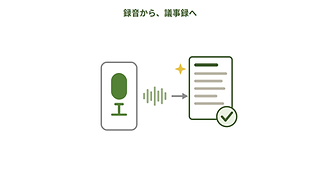
Simple AI Auto-Generation of Meeting Minutes
Overview
In four steps—record → transcribe → draft with generative AI → have a human verify—it walks through how to make meeting minutes and handover materials from a single smartphone, down to the specific app names. By turning what was said into a record, you can reliably leave decisions and a senior’s experience with the team.

August 2026
Network Diagram
Overview
A tool that organizes the necessary work and its order into a single diagram by working back from the final deliverable (the goal). By looking ahead to later steps, you prevent overlooking foreseeable tasks and the last-minute “we won’t make it.” The branching of parallel work becomes the division of roles, and each task’s deadline is set from the main event date. Make a first draft with generative AI and finish it with human verification.

August 2026
Kanban Board
Overview
A very simple progress-management tool that simply turns tasks into one card each and posts them in three columns—To Do / In Progress / Done. Through the “transparency” of everyone seeing the status of all work, duplication and neglect decrease, and much of the back-and-forth of asking about and reporting progress becomes unnecessary. You can start in minutes with a wall and sticky notes, or with Miro.

August 2026
Persona + Package Design
Overview
A tool for depicting the person you want to reach as one fictional individual (a persona) with a name and even an age, and, together, designing on a single sheet the value (a package) that answers their troubles. Rather than ending at “for everyone,” you fix the plan’s axis toward a person whose face you can see. Because portraits and images can be made with generative AI, many teams make use of it.

July 2026
Root-Cause Analysis Logic Tree
Overview
In problem-solving, you need to act on the cause behind the phenomenon, not the immediate phenomenon. It is a tool for systematically digging into causes, visualizing them in a tree diagram, and identifying essential challenges. Writing them out while discussing as a team lets you escape off-the-cuff solutions.

July 2026
Journey Map: Basics
Overview
A framework that visualizes the challenges of each scene along the emotions in the course of a user experiencing a service. You can review an event or app you planned from “the side of the people who use it.” It is a guide for becoming able to create a full journey map for a local challenge you are interested in.

July 2026
Creating a Project Charter
Overview
Introduces the elements you should align with stakeholders when starting a project, and how to proceed. By repeatedly holding heart-to-heart discussions through creating the charter, “what we are doing it for” becomes less likely to waver partway through the activity.


HIJIVEGE
After the Project: HIJIVEGE Takes a Station Stall to a Town Specialty [In progress]
Overview
The Hiji Station Marché began as a coursework project and, after the course ended, carried on as HIJIVEGE, a student-run group. Over the following year, the group sold produce at events in and around town, appeared on television, radio and in newspapers, built partnerships with growers and businesses, and moved on to developing a local specialty product from imperfect tomatoes.

2026.9.26.
Campus Toolbox Is Now Open to the Public in Beta
Summary (partly AI-generated)
Campus Toolbox, which presents methods and case studies of student-led solutions to local issues, is now open to the public as a beta version. We will continue to expand its content, and we are inviting student projects to be featured as case studies.
At Campus Toolbox, we use your feedback to improve the site.
We welcome your comments, requests, and impressions.
About This Site
This site is developed and operated through joint research with Ritsumeikan Asia Pacific University, as part of a public-interest project of the Institute of Administrative Information Systems, to advance student-led solutions to local challenges. The site will be improved and expanded on an ongoing basis, and its content may change without notice. Thank you for your understanding.→ See the Terms of Use

