
Ritsumeikan Asia Pacific University (APU)
April–July 2026
Project period:
Turning the marché into a place of learning — the quiz ‘Veggie Q’ that conveys farmers’ dedication
Editor:
Campus Toolbox Editorial Team + Veggie Q

Highlights of the 2026 activities
At a sales-centered marché, growers’ dedication is hard to convey to consumers. Three students interviewed an organic farmer, translated that dedication into the quiz “Veggie Q,” and exhibited it at a local food fest. Thirty-five people took part, satisfaction was 4.6 out of 5, and vegetable sales that day exceeded the usual—leading to an invitation from the farm to exhibit again in winter.
Tags:
Local Industry & Agriculture Hiji Town, Oita Government–Academia Collaboration
Background & Challenge
Problem-Solving Approach
・Bringing a “place to learn” into a “place to sell”: brought participatory, learning content into a sales-centered event
・Turning a direct interview with a farmer into a quiz: built the questions from what we heard in the fields, and had Aoi Farm provide its vegetables as prizes
・A light booth—zero inventory, a single PC: unlike selling goods, carried no inventory and delivered the content with one PC
Results Achieved
・35 participants; satisfaction averaged 4.6/5 (top rating 65.7%)
・65.7% “learned something about organic farming for the first time.” Comments included “Now I understand why they’re so sweet” and “From now on I want to choose organic vegetables”
・Vegetable sales that day were 69 units (usual 40–50). Aoi Farm invited the team to exhibit again at the winter “Yasa-Eat”
Support from Government & Community
Government support: The Hiji Town Hall provided the exhibition opportunity (Yasa-Eat Fest 2026) and cooperated from the pre-event meetings through running the day. Community cooperation: Aoi Farm (hosting the interview, providing prizes, and inviting the team to exhibit again in winter). Costs incurred: only printing the thank-you cards (under ¥1,000). Carrying no inventory, we delivered the content with a single PC, and the prizes were provided by Aoi Farm.
The Story
The APU College of Sustainability and Tourism emphasizes practicum in the local field, and as part of this it has run student-led problem-solving projects (Field Practicum) continuously with the Hiji Town Hall since fiscal 2023. This article is a record of one of those fiscal 2026 projects: the initiative of the agriculture team ‘Veji-Q.’
Contents
Not letting it end at “that was fun”
Turning stories heard in the field into a quiz
The day — from preschoolers to adults
Points we devised
Difficulties and points for reflection
What we learned
Outlook ahead
1 Not letting it end at “that was fun”
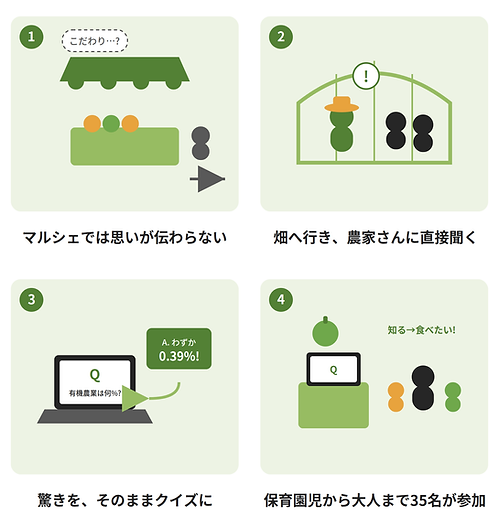
As our team worked on Hiji Town’s local challenges in the Field Practicum, we focused on agriculture. Conventional farming experiences such as rice planting and harvesting tend to end with the impression “that was fun,” and are hard to connect to a concrete image of or interest in farming as work. In Hiji Town, only 4% of residents aged 18 and over are engaged in agriculture, forestry, and fisheries, and a shortage of workers and an increase in abandoned farmland are advancing. Furthermore, because local marché events center on sales, even when you try to convey producers’ dedication, visitors drift away. Where these two challenges overlap, we set the theme of “creating content that makes people learn about agriculture enjoyably at the marché.”
In setting the theme, cutting away early what we couldn’t do and narrowing focus to what we could surely do led to how easily we could act afterward.
2 Turning stories heard in the field into a quiz
On June 10, 2026, we visited Aoi Farm, where a married couple practices organic farming, and heard directly about their thoughts on and ingenuity in farming. Not relying too much on chemical fertilizers, drawing out the power of the soil and the vegetables’ innate vitality. Vegetables raised healthily are also less prone to disease and pests. We were also allowed into the fields and took photos to use in the quiz.
The stories we heard here became the ‘Veji-Q’ questions as they were. For example, we created questions like “Of the vegetables grown in Japan, about how much is by organic farming?” (answer: just 0.39%) and “What harvesting ingenuity protects the tastiness of the rare ‘salad pumpkin’ that can be eaten raw?”, based on what we heard in the interview and on data about organic farming.


In parallel, at a meeting with the Hiji Town Hall we heard a concrete image of the “Yasa-Eat Fest” day, clarified the role division within the team, and advanced production. However, the production period had no leeway, and because revisions to the quiz and design continued until just before completion, we could not secure time to have children try it beforehand and improve it.
3 The day — from preschoolers to adults
At Yasa-Eat Fest 2026 on June 28, Aoi Farm provided vegetables as prizes, and we ran the quiz. There were 35 participants. Not only the elementary-to-junior-high students we had assumed, but a wide range of ages from preschoolers to adults took part. We could directly hear voices such as “I understood why organic vegetables are so sweet,” “They’re expensive, but I want to try them,” and “From now on I want to choose organic vegetables,” and in the survey, 65.7% answered that there was “something I learned for the first time.” Satisfaction averaged 4.6. Vegetable sales on the day were 69 units, exceeding the usual (40–50).
On the other hand, the day’s operation was run by two members, with full support from the Hiji Town Hall’s staff. We had to handle calling people in, explaining the quiz, collecting surveys, and distributing prizes all at once, and there were moments when waiting time arose. We felt that about four operating staff would be ideal.

4 Points we devised
・Focused on “getting people to know” rather than selling, bringing learning content into a sales-centered venue
・Built the questions around the stories heard in the interview, and had the farm provide its vegetables as prizes
・Made it a form that could be provided with a single PC, holding no inventory
・Distributed to participants a thank-you card noting Aoi Farm’s Instagram

5 Difficulties and points for reflection
・Our assumption about the target age was naive. Because we made it mainly for elementary students, there were moments when it was difficult for preschoolers and unsatisfying for adults. We should have not limited the age and given it a range, from easy questions to ones requiring knowledge
・There were time slots where more visitors than imagined meant we couldn’t keep up. We should have designed in advance the movements and role division for busy times
・The production schedule had no leeway, and we could not take a test period to actually have children try it and improve it
6 What we learned
The importance of not letting what we learned end with ourselves, but conveying it to suit the other party. That outreach through experience and enjoyment is more effective than difficult explanations. And that organic farming is not simply reducing pesticides and fertilizers, but an endeavor that makes use of nature’s power while considering the relationship with soil and living things.
More than anything, the biggest harvest of this activity was that the feeling of “I want to do something for the community” sprouted not as something tackled as an assignment, but as our own honest feeling.
7 Outlook ahead
We plan to exhibit at the winter “Yasa-Eat” to which Aoi Farm invited us. There is still room for improvement in the content, such as a structure that a wider age range can enjoy, and incorporating video and audio. Because ‘Veji-Q’ can be provided with a single PC and no inventory, it should be applicable to other products and other regions too.
Advice for Future Teams
Reusable Knowledge
・It works with a single PC and zero inventory: unlike selling goods, there’s no risk of unsold stock, and the content can be delivered with one PC
・Swap the subject matter and it applies to other products and themes: by changing the question text and photos, you can adapt it to a different target
・A production method of building questions from what you heard in an interview: because content heard directly from growers becomes the questions, it has substance you can’t create from desk research alone
・Make the prizes local products: you can connect the learning content with the region’s products
・Costs are printing only (under ¥1,000): you can start without subsidies or equipment to prepare
Team / Author Profile

Members: Minami Takayama (APU 3rd year), Maho Kuboi (APU 1st year), Reiko Kita (APU 3rd year)